烟灰颜色、结构与燃烧完全程度的技术关联
The color and structure of ash are the most intuitive physical indicators for judging the completeness of tobacco combustion. This article systematically interprets the underlying chemical and physical mechanisms from a technical parameter perspective.
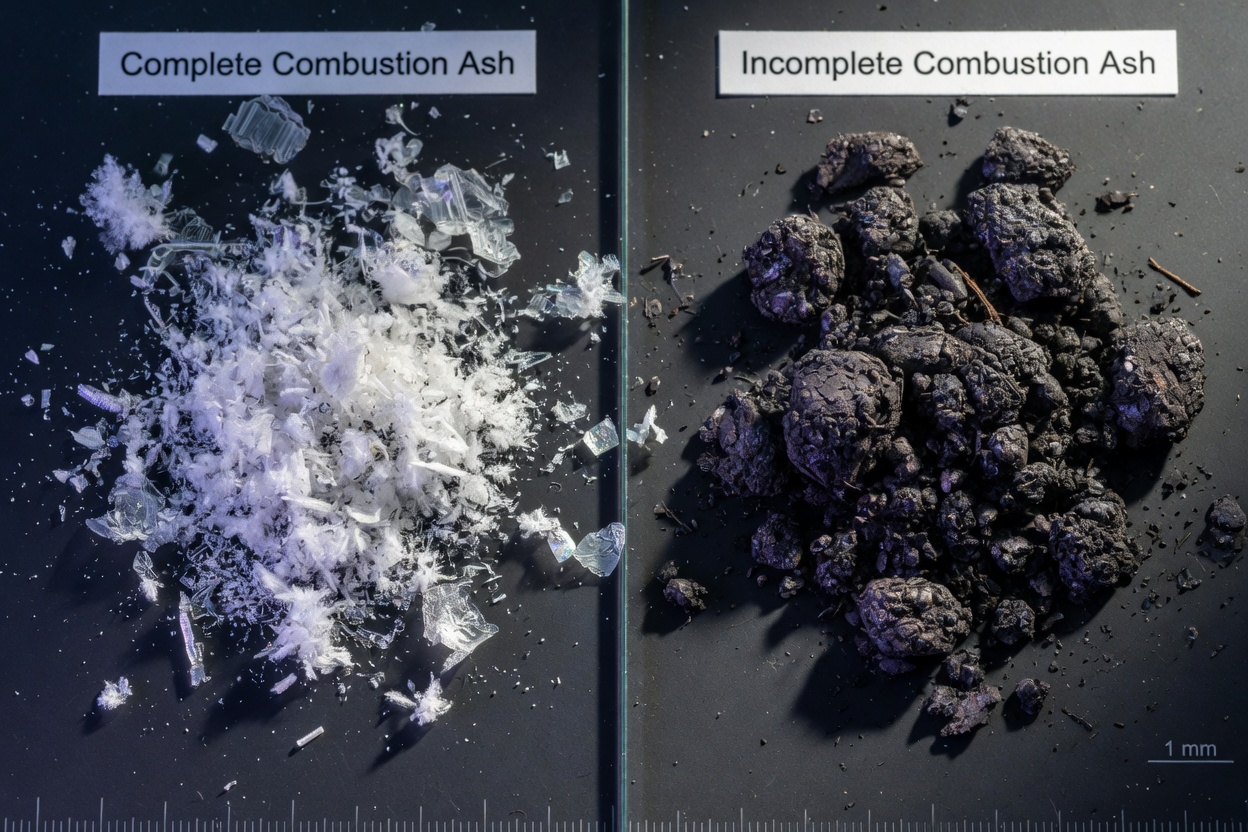
Technical Correlation of Ash Color, Structure, and Combustion Completeness
Author: [Technical Expert Perspective]
Date: 2026-08-13
Introduction: Starting from an Abnormal Combustion Test
In the study of tobacco combustion processes, the most intuitive conclusions are often hidden in the residues regarded as "byproducts."
I remember it was a late night in the deep autumn of 2023, in the combustion stability testing room of a major tobacco laboratory in Yunnan. At that time, we were conducting thermal stability experiments on a new type of high-strength tobacco shred. A set of control group data showed that the combustion efficiency was within the theoretical range, but one detail reported by the observer was extremely abnormal: the ash color showed an unnatural, deep dark purple, and at the end of the combustion, the ash structure exhibited a strong "viscous feel" rather than the normal loose granular state.
This phenomenon sparked discussion within a small circle at the time. Some thought it was a chemical reaction from additives, others blamed environmental humidity. But when I observed those dark purple ash residues under a microscope and cross-analyzed them with Thermogravimetric Analysis (TGA) data, I realized this was essentially a typical failure case of the coupling relationship between Color, Structure, and Combustion Completeness.
Through this review, I developed a set of technical logic for determining quality based on observable parameters.
I. Color: The "Visual Fingerprint" of Combustion Chemistry
Ash color is by no means accidental; it is a comprehensive visual representation of redox reactions, carbon residue levels, and mineral distribution within the combustion zone.
1. Linear Correlation Between Carbon Residue and Hue
The most direct manifestation of combustion completeness is the oxidation degree of carbon (C). Under complete combustion, carbon should be converted to $CO_2$ and released. If combustion is incomplete, residual microscopic carbon particles (Char) directly change the ash's chroma.
- **Light Gray/Silver White**: Indicates extremely high combustion completeness. Carbon residue is minimal, and the ash consists mainly of metal oxides (such as $K_2O, CaO, MgO$).
- **Dark Gray/Black**: Indicates significant unoxidized carbon. This usually occurs under insufficient oxygen supply or excessively low local temperature.
- **Dark Purple/Dark Brown**: A more complex color, typically pointing to complexation between specific mineral components and incompletely oxidized organic fragments.
2. Modulation Effect of Minerals on Color Tone
In laboratory quantitative analysis, we found that ash color is significantly influenced by alkali metal and alkaline earth metal content. For example, tobacco shreds with higher potassium (K) content tend to have a more pronounced light yellow or light gray tone; while shifts in the ratio of calcium (Ca) and magnesium (Mg) cause the ash color to drift toward deeper, darker shades.
In that 2023 test, the appearance of dark purple was actually due to the local combustion temperature failing to reach the threshold required for complete mineral oxidation, causing partial organic matter to carbonize at high temperatures and form complex chroma complexes with specific metal ions.
II. Structure: The "Physical Barrier" of Oxygen Delivery
If color represents the chemical feedback, then ash structure represents the physical feedback. The morphology of ash directly determines the gas-phase transport efficiency during combustion.
1. Porosity and Permeability
A healthy combustion process requires an ash bed with a certain degree of porosity. This structure allows fresh air to penetrate the combustion front through capillary action and diffusion.
- **Loose Structure**: High void ratio, allowing oxygen to penetrate evenly and maintain a stable combustion temperature zone.
- **Dense Structure**: When ash slag forms a compact, "clumped" morphology, the effective porosity drops sharply. This creates a "shielding effect," cutting off oxygen supply to the combustion core.
2. Viscosity and "Clumping" Phenomenon
In practice, we often encounter a "hard ash" problem. When combustion temperature fluctuates significantly or when sugar content and binder levels in the tobacco shred are abnormal, the ash undergoes secondary clumping during cooling. This structure not only increases combustion resistance but, more importantly, alters the heat conduction path, trapping heat inside the ash and preventing efficient transfer to surrounding tobacco shred, thereby further reducing thermal efficiency.
III. Coupling Logic: The Vicious Cycle of Color and Structure
This is what I believe deserves the most attention from production process personnel: Color and structure do not exist in isolation; there is a dangerous positive feedback (vicious cycle) mechanism between them.
The logical chain is as follows:
Combustion environment fluctuation (oxygen deficiency/low temperature) → Increased carbon residue → Darker ash color → Formation of dense carbon-based structure → Physical oxygen shielding → Further reduction of combustion completeness → Darker color and denser structure.
This coupling effect can lead to "extinguishing" or "burn-out" risks in the later stages of combustion. In a stability test of a certain brand of tobacco, I recorded a set of typical data: when the ash gray value dropped from 4.2 (Light Gray) to 1.8 (Dark Gray), the ash porosity correspondingly plummeted from 65% to 28%. Such a dramatic physical change marks the critical point where the combustion system loses its self-regulating ability.
IV. Practical Guide: Parameter-Based Quality Assessment
Based on the above theoretical analysis, I recommend establishing a "Parameter Matrix" for field inspections or rapid laboratory assessments:
| Observation Dimension | High Quality Indicator | Warning Indicator | Potential Cause Analysis |
|---|---|---|---|
| **Color** | Light silver-gray, bright white, uniform tone | Dark gray, dark brown, local black spots | High carbon residue, uneven oxygen distribution |
| **Structure** | Granular, loose, friable | Clumped, dense, sticky | Abnormal sugar/binder content, temperature fluctuations |
| **Morphology** | High porosity, even distribution | Continuous "ash crust," collapse | Obstructed combustion front, impaired heat conduction |
Expert Advice:
If you observe ash that appears "dark and hard" in the field, do not merely attribute it to insufficient combustion. Also check the physical properties of the tobacco shred (such as whether rolling pressure is too high, restricting oxygen channels) and the stability of the combustion environment.
Conclusion
Ash is not merely the residue of combustion; it is the "black box" of the combustion process. Through deep deconstruction of color and structure, we can not only judge the current combustion quality but also trace back to subtle defects in the production process. On the path to pursuing the ultimate combustion experience, the details often lie in the shades of gray.
※ Gray value determined by standard laboratory gray scale card comparison method